
Today, on Redhead Mom, I’m sharing a partnered guest post about laser treatment and spider veins, redness, and Rosacea.
A Knoxville nurse explains what the little red lines by your nose actually are, what a laser does to them, what it feels like, and when a doctor should look first.
By Sarah Hitchcox, RN, BSN
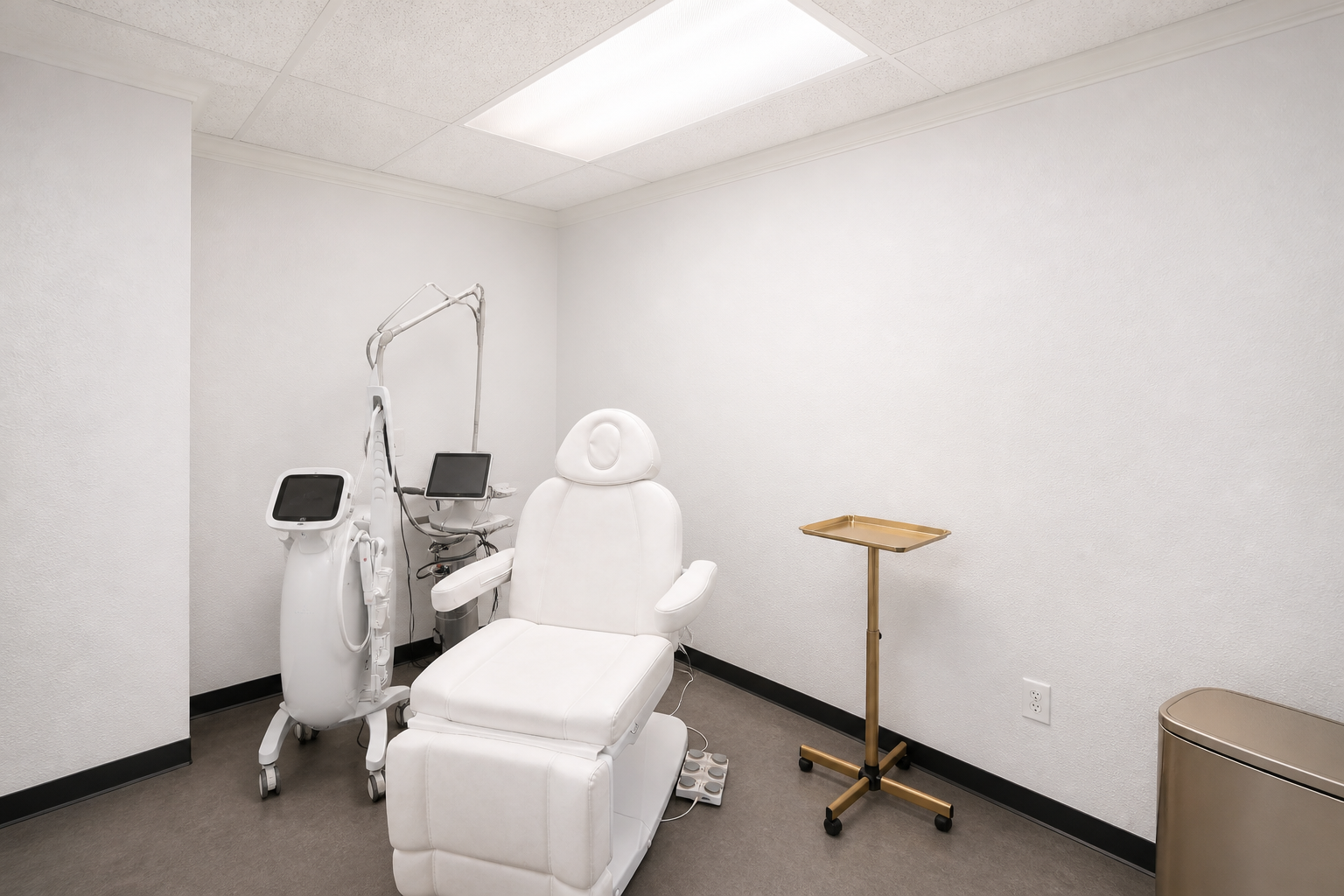
A laser treatment room: a reclining chair, the laser cart, and a tray. Most patients drive themselves home afterward.
Most of the women who ask me about redness didn’t come in for redness. They came in for something else, and halfway through the visit they touch the side of their nose and say, “and what about these?” Tiny red lines next to the nostril. A flush across the cheeks that never fully settles. A patch of little veins on the back of one leg that showed up one summer and stayed.
I’m Sarah Hitchcox, a registered nurse in Knoxville. I spent most of my nursing career in the emergency department before I opened my own aesthetics practice, and I now run two offices, one in Bearden and one in Farragut. This is the conversation I have about spider veins, facial redness and rosacea, written down.
What you’re looking at
Spider veins and broken capillaries are small blood vessels sitting close enough to the surface that you can see them. The redness of rosacea and plain facial redness tend to look less like lines and more like a blush that never goes away. They show up most often around the nose, across the cheeks, and on the legs.
They’re the kind of thing you notice while you’re doing your makeup or washing your face. Nobody else is staring at them. You know they’re there.
Creams don’t reach them. A good routine does a lot for dryness and texture. A visible vessel sits under the surface, though, and a moisturizer or a redness serum isn’t going to close it.
What the laser does
The treatment I offer for this is called vascular lesion reduction. The laser puts its energy into the vessel itself. That heats the vessel and collapses it, and over the following weeks the body breaks it down and reabsorbs it. The skin on top isn’t cut or opened, which is why most patients don’t need any downtime.
It’s used for the tiny veins around the nose, for diffuse redness across the cheeks, and for spider veins on the legs. The face and the legs are separate treatments. Some people pair it with laser treatment for brown spots, since the two problems often live on the same cheeks.
I keep a short page about laser treatment for spider veins and redness in Knoxville (https://hitchcoxaesthetics.com/vascular-lesion-reduction) with the questions people ask most, including the one everybody asks first.
What it feels like
Yes, that one. Most people describe it as a rubber band snap against the skin. It’s quick. Mild discomfort is the honest description, and the treatment is generally well tolerated.
The room looks like any of my treatment rooms: a white reclining chair, a laser cart on wheels with a screen, a rolling tray at my elbow. You drive yourself there and you drive yourself home. Most patients go straight back to whatever they were doing, including the school pickup line.
Realistic expectations

Between sessions, the rules are the ones you give your kids at the pool: sunscreen, a hat, and no tanning beds.
This is the part I’d rather over-explain than under-explain. Once the body has absorbed a treated vessel, that vessel is gone. The thing that produced it is still there, whether that’s your skin, your family, the sun, or the years. New veins can form over time, and when they do, a maintenance visit may be needed.
Redness and rosacea usually get treated as a series, and the change builds over the series instead of arriving all at once. I won’t give you a number of sessions in an article, because I haven’t seen your skin. Results vary from person to person, and the consultation is where we decide whether this is even the right treatment for you.
I’m also not going to tell you what your skin will look like afterward. I don’t know yet. Anyone who promises you that before they’ve looked at you is guessing.
A laser for veins doesn’t touch lines, either. If what bothers you in the mirror is the crease between your brows rather than color, that’s a different tool and a different conversation. I have that one at the Botox-focused practice in Knoxville (https://botoxknoxvilletn.com/), which is another of my businesses at the same offices.
Sun care between sessions
Sun and laser treatments don’t mix well, and that’s true before a session and after one. Between visits, the rules are the ones you already give your kids at the pool. Sunscreen on the treated area every morning. A hat if you’ll be outside for a while. No tanning beds, and no self-tanner on the area, since it changes the color your provider is working with.
I’m not writing out a full protocol here, because the right one depends on your skin and the laser. Ask your provider how long they want you being careful before and after each session, and then do exactly that.
When to see a doctor first
I’m an aesthetics nurse. There are things I want a doctor to look at before anyone aims a laser at them.
- A leg vein that bulges, aches, or comes with swelling, warmth, or a change in the skin around it. That’s a different problem from a spider vein, and it needs a medical evaluation.
- Redness that’s new, that stings or burns, that comes with bumps or irritated eyes, or that nobody has ever diagnosed. Rosacea has more than one form. A dermatologist can tell you which one you have and whether it needs medicine before a laser, or instead of one.
- Any spot that’s changing, bleeding, or crusting. That gets seen, not treated cosmetically.
- If you’re pregnant or nursing, talk to your doctor first and tell your provider. It changes the plan.
None of this is meant to scare you off. Medical questions come first, cosmetic ones second.
Where this happens
Knoxville Laser Clinic is another of my businesses at the same offices, and the laser work runs under that name. You can book a free consultation at the laser clinic (https://knoxvillelaserclinic.com/) online in about a minute, Monday through Saturday, at either Bearden or Farragut.
Wanting the red lines beside your nose gone isn’t vanity. It’s wanting to look presentable, the same reason you’d change a shirt with a stain on it before you walked out the door. If they bother you, that’s reason enough to ask.